A parakeet can be a rewarding pet for someone ready to provide daily interaction, balanced food, a safe home, and routine veterinary care. What makes this small bird’s care manageable is a steady routine, not complicated equipment. The cere is the fleshy skin around a bird’s nostrils. A budgerigar can thrive indoors when you protect it from fumes, direct sunlight, and injury.
You will need time each day for attention and practical care. This guide explains how to make your home safer and support your bird’s health without making pet ownership feel mysterious.
Key Takeaways
- Make time for daily interaction, exercise, and enrichment.
- Offer a balanced diet and clean water.
- Set up a safe cage and remove household hazards.
- Arrange routine visits with an avian veterinarian.
- Learn your bird’s normal behavior so changes stand out.
Make a plan for daily attention before bringing a parakeet home.
Before You Bring Home a Parakeet
A pet budgerigar can be part of your household for 7-15 years, so plan for a lasting commitment rather than a short-term hobby. In the United States, “parakeet” commonly means a budgerigar, also called a budgie. Pet budgerigars can live 7-15 years in captivity.
Could this small parrot fit your life through changing work schedules, moves, or family needs? An adult budgerigar averages about 7 inches from head to tail, but its small size does not make its needs occasional. It needs steady attention and care throughout its life.
Plan for the bird’s whole lifespan, not only the season when bringing it home feels convenient.
Think through who will feed and interact with the bird when you travel or work longer hours. You will also need to budget time for routine care and veterinary visits. A bird’s needs continue when your own circumstances change.
Consider whether everyone in your household is comfortable living with a bird. Parakeets can vocalize, scatter food, and need a reliable daily schedule. A thoughtful decision now can help prevent a rushed rehoming later.
Before adoption, make sure your household can provide steady care through the bird’s full lifespan.
What Does Parakeet Care Require in a Safe Cage?
A safe cage gives a parakeet room to stretch and move while keeping its head and feet clear of the bars. Horizontal space matters because birds move across perches, not just up and down. For one parakeet, choose a cage at least 18 inches wide, 18 inches long, and 18 inches high.
A cage with bars about 3/8 inch apart helps prevent a bird from squeezing through or getting stuck. One easy-to-miss danger is a cage with bars wide enough for a bird’s head to become trapped. Choose the largest suitable cage that fits your home and allows safe movement.
Choose a cage with room to move
Check the door, latches, and frame for gaps or loose parts. The cage should stay secure when your bird climbs and shifts its weight. A roomy interior also leaves space for perches, dishes, and toys without crowding the bird’s flight path.
Add safe perches, dishes, and liner
Use perches at least 4 inches long and about 3/8 inch in diameter. Different perch diameters exercise the feet and provide more than one comfortable grip. Place dishes away from perches to reduce droppings contamination.
Keep separate dishes for dry food, fresh food, and water. A grate can keep the bird above the liner, while paper-based liner makes droppings easier to see. Check cage and accessory materials for lead, zinc, or galvanized metal.
Use this quick setup checklist before your bird moves in:
- Secure cage
- Safe bar spacing
- Varied perches
- Separate dishes
Inspect every cage and accessory for damaged parts or potentially toxic metal before use.
Choose a Safe Location and Remove Household Hazards
A draft-free room that stays between 20°C and 25°C (68°F and 77°F) is a comfortable starting point for a parakeet’s cage. Stable temperatures help your bird stay comfortable. Place the cage where family activity is easy to hear, with a quieter retreat available.
Sunlight through glass does not provide useful UV exposure because windows filter out UV light. Direct sunlight can also overheat a cage, so it is not a substitute for bird-safe UV lighting. Bird-specific full-spectrum UV lighting can be used for 10-12 hours a day.
Find a comfortable spot away from drafts
Choose a spot away from drafty doors, heating vents, and sudden temperature shifts. Your bird benefits from seeing ordinary household activity, but it also needs a calm place to rest. If you use UV lighting, follow its instructions and keep the cage out of direct sunlight.
Keep fumes and other hazards out of reach
Overheated nonstick cookware can release fumes that are fatal to birds. Aerosolized cleaning products can also expose a bird to harmful fumes. Keep ceiling fans off when a bird is loose, and close open windows to reduce escape and injury risks.
Electrical wires can invite chewing, while other pets may frighten or injure a bird. Check the room before allowing any supervised activity outside the cage. Keep these hazards on your home check:
- Nonstick cookware
- Aerosols
- Ceiling fans
- Open windows
- Dangling wires
Keep the cage out of the kitchen because overheated nonstick cookware can release fumes that are fatal to birds.
Build a Balanced Parakeet Diet
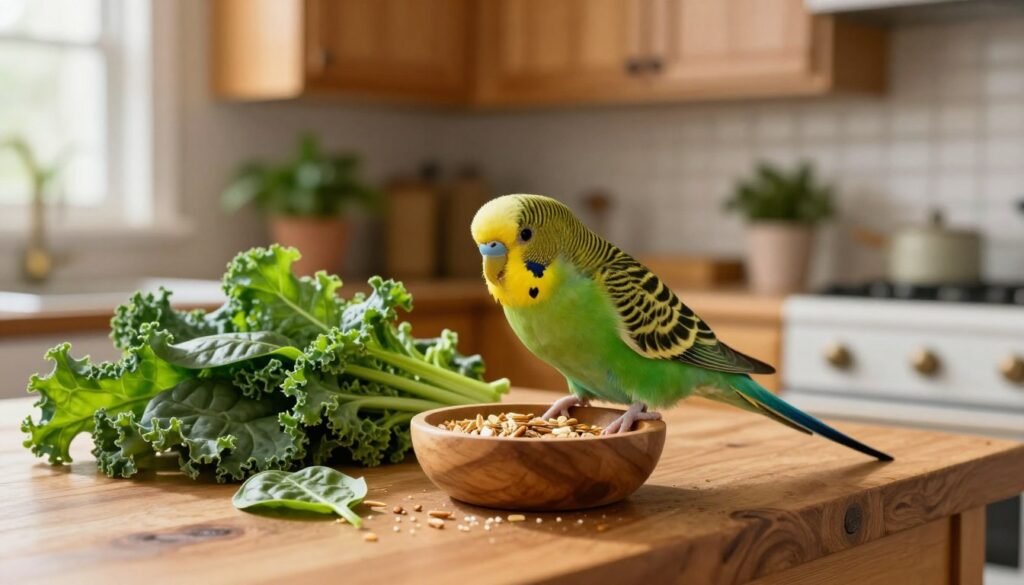
A balanced parakeet diet uses formulated pellets as its staple and adds vegetables, greens, and small treats. Fresh water should always be available. Pellets can make up 60 to 80 percent of a budgie’s diet, with vegetables and leafy greens at about 20 to 25 percent.
These shares give you a practical starting point for offering food each day. Use clean water and check that the bird can reach it easily. Budgerigars remove seed hulls themselves, so they do not need grit to grind food.
Make formulated pellets the staple
Offer a quality formulated pellet as the main food, alongside vegetables and leafy greens. A seed-heavy diet alone does not provide the same balance. If your bird has eaten mostly seeds, change its food gradually over two to four weeks.
| Food | Amount or share | How often | Care note |
|---|---|---|---|
| Formulated pellets | 60 to 80 percent | Daily staple | Use as the main food |
| Vegetables and leafy greens | About 20 to 25 percent | Offer regularly | Wash fresh produce |
| Fruit and seed treats | A few small fruit pieces; 1-2 teaspoons of seeds and grains | Fruit a few times weekly; seeds daily as treats | Keep treats measured |
Add fresh foods and use seeds as treats
Try leafy greens, broccoli, bell peppers, berries, or papaya for variety. Offer a few small pieces of fruit a few times a week. Measure a teaspoon or two of seeds and grains per day for treats or training rewards, not as the main food.
Remove uneaten fresh food after two to four hours. Avocados, fruit seeds, chocolate, caffeine, and alcohol are toxic to birds. Avoid offering these foods, even in small amounts.
Keep familiar food available during a gradual change from seeds to pellets, and watch that your bird continues eating. During a pellet transition, keep familiar food available and monitor that the bird continues eating.
Set a Daily Routine for Cleaning, Sleep, and Grooming
A simple daily routine prevents dirty dishes and discarded food from becoming a hygiene problem. Daily cleaning also helps you notice changes in the habitat. Wash food and water dishes every day, spot-clean the cage daily, and replace its paper liner at least weekly.
Use bird-safe cleaners only, then rinse and dry the habitat thoroughly. Returning a bird before cleaner residue and odors are gone is a specific cleaning mistake to avoid. Keep the cleaning routine simple enough to follow consistently.
Keep food, water, and the habitat clean
Remove soiled paper and droppings during daily spot-cleaning. Check that food and water dishes are clean before refilling them. A weekly liner change gives you a clear surface for noticing changes in droppings.
| Care task | Frequency | Practical check |
|---|---|---|
| Wash dishes | Daily | Food and water dishes are clean |
| Spot-clean and replace liner | Spot-clean daily; replace paper at least weekly | No soiled paper or visible droppings remain |
| Provide nighttime sleep | 10 to 12 hours nightly | Quiet, uninterrupted rest |
Protect sleep and handle grooming carefully
Parakeets should ideally get 10 to 12 hours of sleep at night. Protect a quiet stretch of rest from household noise and interruptions. If your bird does not bathe, you can gently mist it with warm water a few times a week.
Nail trimming may be needed every few weeks to months. Ask a trained professional to help if you are unsure how to trim safely. Most beaks do not need trimming, so avoid trying to shape one at home.
Return the bird only after the cleaned habitat is completely dry and free of cleaning-product odors.
Keep Your Parakeet Busy With Social Time and Training
Parakeets stay engaged when they get daily attention, chances to move, and safe activities to explore. At least 30 minutes of human interaction each day is a useful goal. Provide at least three enrichment toys and supervised activity in a bird-proofed room.
Rotate chewable, shreddable, and foraging toys so your bird has different ways to explore. Supervised out-of-cage activity gives it room to move, but the room must be secured first. A new bird may need time before it accepts handling.
Offer daily enrichment and safe flight
Choose toys that encourage safe chewing, shredding, and foraging. Rotate some toys rather than leaving every option in place all the time. Watch how your bird uses each item, and remove toys with broken or unsafe parts.
Build trust through short training sessions
Speak calmly and repeat simple cues patiently. Reward a small step toward interaction, then give the bird time to respond. Stop when your bird looks fearful; expecting a new bird to accept handling immediately can make trust harder to build.
Use these simple steps to begin:
- Speak calmly.
- Offer a treat.
- Invite a step-up.
- End on a calm note.
Keep sessions brief and let your bird set the pace. Some parakeets mimic words and sounds, but not every bird will talk. Calm repetition gives a bird a chance to hear familiar words without pressure.
Never chase or force a frightened bird to complete a training session.
Plan Preventive Veterinary Care
Arrange a yearly checkup with an avian veterinarian even when your budgie looks healthy. Routine visits help establish a baseline for your bird’s health. Ask whether routine bloodwork or parasite screening is appropriate.
Choose a veterinarian who has experience treating birds. A regular checkup gives you a chance to discuss your bird’s condition and care. Keep the clinic’s contact information easy to find.
Schedule routine checkups
Plan a veterinary visit every year, even if your bird seems active and eats normally. Ask the veterinarian which screenings fit your bird’s age, history, and health. Birds can hide illness, so an established care relationship can help you act promptly when changes appear.
Separate and monitor new birds
Keep a new bird in a separate quarantine space for at least 30 days. A bird that appears healthy still needs quarantine before meeting birds already at home. This separation lowers the chance of spreading an infection.
Arrange a veterinary check for the new bird before introductions. Tell the clinic that the bird is newly acquired and ask how to keep the quarantine setup separate. Do not shorten the separation because the bird seems well.
Keep a new bird separate for at least 30 days before introducing it to resident birds.
Which Changes Mean a Parakeet May Be Sick?
A sudden change in a parakeet’s normal behavior or appearance deserves prompt contact with a veterinarian. Small changes matter because birds may hide illness until they have been sick for several days to weeks. Contact a veterinarian promptly when your bird’s usual pattern changes.
Watch how much your bird eats and drinks, how active it seems, and whether its weight changes dramatically. Weakness, listlessness, or sleeping more than usual can also point to illness. Compare droppings with your bird’s usual pattern.
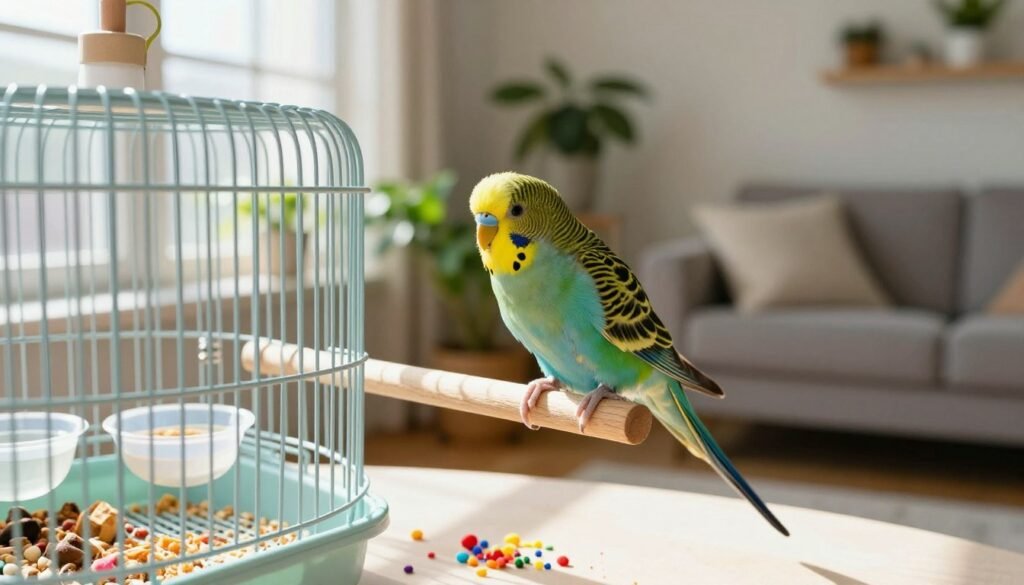
Watch for changes in appetite, activity, and droppings
Reduced appetite, unusual drinking, or fewer droppings deserves attention. Diarrhea or an unusual droppings color can also signal illness. A change in behavior or appearance is more useful than trying to diagnose the cause at home.
Look for these warning signs:
- Reduced appetite
- Unusual drinking
- Weakness or listlessness
- Sleeping more
- Changed droppings
- Breathing trouble or tail bobbing
Treat breathing trouble and loss of perching as urgent
Open-mouth or labored breathing, wheezing, and nasal discharge can signal illness. Tail bobbing with each breath is another warning sign. Sitting on the cage floor for an extended time or no longer perching also calls for prompt veterinary contact.
If veterinary care is temporarily unavailable, keep the sick bird in a room at least 85°F and protect it from drafts. This warm setting is interim support, not a substitute for veterinary care. Call a veterinarian as soon as care is available.
Do not wait for a breathing problem or loss of perching to resolve on its own.
U.S. Import Rules for Pet Parakeets
A parakeet’s U.S. import requirements depend on the shipment size, route, and the bird’s origin. Route and origin change which documents and quarantine steps apply. A USDA pet-bird shipment means five or fewer birds, not intended for resale, and not poultry.
Requirements also depend on whether a bird is U.S.-origin and whether it originated from or traveled through a highly pathogenic avian influenza-affected country or zone. Plan the route and paperwork before arranging shipment. The rules below distinguish common entries from Mexico and Canada.
Check whether the shipment meets the pet-bird definition
The USDA pet-bird category applies to a shipment of five or fewer birds entering the United States. The birds must not be poultry and must not be intended for resale. A shipment outside this definition may follow different requirements.
Follow the permit and route requirements
Apply for a USDA pet-bird import permit at least 7 business days before shipment. The permit is valid for 30 days and must accompany the shipment. Birds entering from Mexico must arrive by air or sea, not through a land border port.
Mexico entries require an import permit, a veterinary health certificate, port inspection, and a 30-day federal quarantine. The route matters, so do not plan a land-border arrival for a Mexico-origin bird.
Confirm requirements for the bird’s origin
Canada’s entry requirements differ by route when Canada is free of highly pathogenic avian influenza and Newcastle disease. Canada entries at a land border port need inspection, but no import permit or veterinary health certificate under that disease-free condition. By air or sea, they need a permit and inspection, but no health certificate under the same condition.
| Origin and route | Permit | Health certificate | Inspection or quarantine |
|---|---|---|---|
| Mexico by air or sea | Required | Required | Port inspection; 30-day federal quarantine |
| Canada by land | Not required if Canada is free of both diseases | Not required if Canada is free of both diseases | Port inspection; no federal quarantine listed |
| Canada by air or sea | Required | Not required if Canada is free of both diseases | Port inspection; no federal quarantine listed |
| Non-U.S.-origin or returning U.S.-origin bird from an affected zone | Required | Required | Port inspection; 30-day federal quarantine |
Non-U.S.-origin birds and U.S.-origin birds returning from an affected country or zone require a permit, veterinary health certificate, port inspection, and 30-day federal quarantine.
Confirm current entry requirements for the exact origin and route before arranging shipment.
Decide Whether One Parakeet or a Pair Fits Your Home
A single parakeet can thrive with consistent attention, while a compatible pair can provide company of its own kind. Your daily time is central to the choice. A single bird needs dependable interaction with you, while two or more parakeets may bond with one another.
One bird can form a close bond with its caregiver. A pair may enjoy same-species companionship, but adding another bird does not remove the need for your care. Think about the time you can reliably give before choosing.
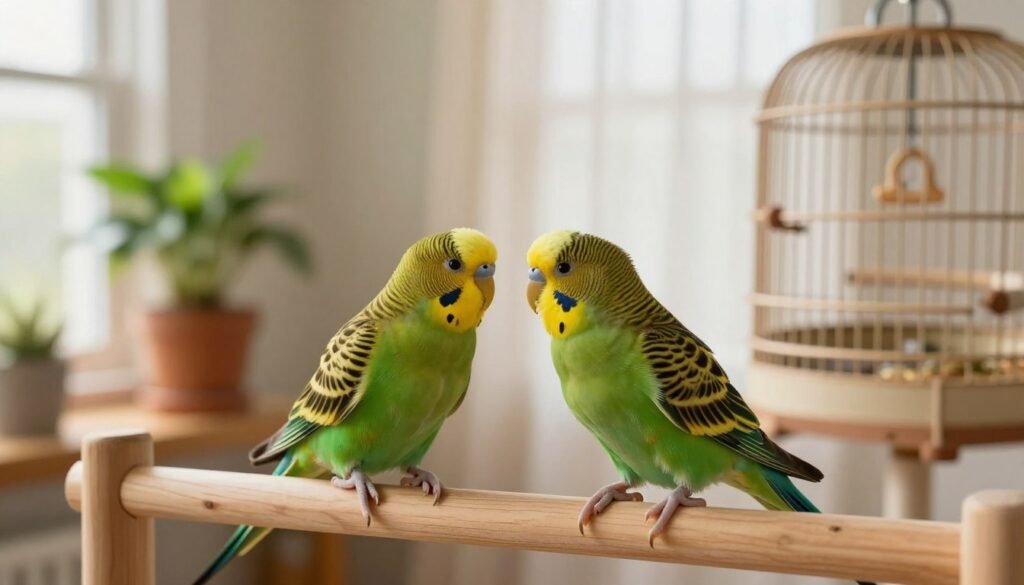
Social birds should not be placed together immediately just because they are the same species. Introduce them gradually in neutral territory, with close supervision. Watch their body language and behavior, and separate them if either bird appears stressed or aggressive.
Same-species companionship does not guarantee that two birds will get along. A safe introduction depends on their behavior, not their species alone.
Give both birds room to retreat during a meeting. Keep early interactions brief enough to end before tension builds. If the birds do not settle calmly, try again later rather than forcing contact.
Keep birds in separate cages if their introductions are not calm and safe.
Conclusion
A healthy, well-adjusted parakeet depends on safe surroundings and dependable care every day. Consistency with food, housing, attention, and veterinary care gives your bird a steadier routine. Small daily habits can make care easier to sustain.
Choose a schedule that fits your household and keep it even when life gets busy. Before bringing a parakeet home, identify an avian veterinarian and prepare the cage, food, and daily schedule.