
A cockatiel’s daily diet should be based on formulated pellets, with a limited amount of fresh produce, only a small role for seeds, and clean water available at all times. Formulated pellets are nutritionally balanced manufactured pieces designed to serve as a bird’s staple food. For bird owners, daily feeding can become a simple, healthy routine once you know what belongs in the bowl. A pet bird that favors seeds may take time to accept other foods, so pay attention to what disappears.
Key Takeaways
- Build the daily menu around formulated pellets.
- Offer vegetables and fruit in measured portions.
- Keep seeds to a small part of the diet.
- Provide clean water throughout the day.
- Watch what your bird eats, not just what you serve.
Start by checking what your bird actually eats, not just what you put in the bowl.
What Do Cockatiels Eat Every Day?
For a healthy adult cockatiel, make formulated pellets the main part of the daily diet and reserve a smaller share for fresh produce. A balanced mix gives your bird a consistent nutritional foundation while adding variety through vegetables and fruit.
Pelleted food formulated for birds should supply approximately 75%-80% of the diet. Fruit, vegetables, and greens should make up no more than 20%-25%. Seeds belong only in a very small part of the daily menu, not as a complete food.
| Food group | Daily share | Role |
|---|---|---|
| Formulated pellets | Approximately 75%-80% | Nutritional foundation |
| Fresh fruit, vegetables, and greens | No more than 20%-25% | Variety and nutrients |
| Seeds | Only a very small part | Not a complete diet |
Wild food changes with the seasons, but a captive cockatiel needs a dependable, balanced menu every day.
Cockatiels are native to Australia, where wild birds eat seeds, fruit, and vegetation as seasonal food availability changes. A bowl at home cannot copy that shifting landscape, so a balanced captive diet matters. Variety should come from suitable fresh food alongside a consistent staple, rather than from letting your bird choose only familiar pieces.
Vitamin A deficiency and insufficient dietary calcium are among the nutrition-related problems cockatiels can face. A balanced diet helps address these concerns, while an individual bird’s needs can differ with health and life stage. Avoid making a major diet change based on a single food preference or a food bowl that looks varied.
Keep the proportions as a practical starting point, and ask an avian veterinarian about changes for a bird with specific health needs.
Make Formulated Pellets the Daily Foundation
Put the pellet bowl in place first thing in the morning, before offering other food. Cockatiels are often hungriest then, making this a useful time to present their staple food. Formulated pellets are designed as a nutritionally balanced food for birds.
Offer pellets before other foods in the morning, then check that your bird eats them. Unlike a bowl that lets a cockatiel pick preferred bits, pellets provide a consistent formulated food. That consistency helps you build a routine around the intended staple instead of relying on whatever pieces the bird happens to select.
Pellet formulas are available for different life stages. A young bird and an adult may not need the same formulation, so consider the bird’s age and health when choosing one. Your avian veterinarian can help assess which product is appropriate for your cockatiel.
Keep the bowl easy to reach and look at its contents after meals. A bowl that still looks full does not tell you whether your bird has eaten enough, especially if food has spilled or been moved around. Notice whether pellets are actually missing and whether your cockatiel is eating them.
Check that the bird is eating the pellets rather than merely leaving them in the bowl.
Choose and Prepare Fresh Vegetables and Fruit
Offer a small, varied portion of vegetables and fruit each day, with vegetables and greens taking priority over fruit. Colorful vegetables and dark leafy greens are useful choices for nutrients, while a little fruit adds variety.
Choose bell peppers and dark leafy greens often, and keep fruit portions modest. Fresh food belongs in a separate dish, which makes it easier to see what your cockatiel has eaten. Repeated exposure can help a bird become familiar with new choices, even when the first serving goes untouched.
| Fresh-food group | Examples | What it adds |
|---|---|---|
| Brightly colored vegetables | Bell peppers | Vitamin A |
| Dark leafy greens | Dark leafy greens | Calcium |
| Fruit choices | Mango and papaya | Fiber, with less sugar than temperate fruits |
Mango and papaya are suggested fruit choices because they have more fiber and less sugar than temperate fruits. Prepare every serving carefully, and do not leave fresh food sitting in the cage for the whole day. These four checks make daily preparation straightforward:
- Wash produce thoroughly before serving.
- Cut vegetables and fruit into small pieces.
- Remove apple seeds before offering apple.
- Remove uneaten produce within a couple of hours, especially in warm climates.
Keep the fresh-food dish separate from the pellet bowl so your cockatiel can reach each food easily. A new texture or shape may take several tries to seem familiar. Offer just a small portion of each choice, so you can see which foods interest your bird without leaving a large serving behind.
If your cockatiel ignores a safe new food once, offer it again on another day rather than treating one refusal as a permanent preference.
Keep Seeds as a Small Part of the Diet
A cockatiel can enjoy seeds without receiving a complete diet from a seed bowl. Keep them to a small role in daily feeding rather than relying on seeds as the staple food.
A seed-only menu can lead to ill health and potentially a shortened lifespan. Commercial seed mixes commonly contain four to ten kinds of seeds and nuts. That range can make a bowl look varied, but the mix tends to be high in fat and carbohydrates and limited or imbalanced in nutrients.
The problem is not only what a seed mix contains. Cockatiels may select one or two favorite kinds and leave the rest behind, so the food your bird eats can be less varied than the bowl appears. A generous-looking mix does not ensure that each serving provides a balanced range of nutrients.
Seeds can still have a modest place in feeding. The important difference is whether they supplement a balanced menu or replace it. If your bird has grown used to a seed-based food, change the diet with care rather than taking away the familiar option at once.
Watch which seeds disappear and which remain. A bird that eats only favorites may need a slower adjustment than one that already samples different foods. The contents of the dish matter less than the foods your cockatiel actually consumes.
Do not remove a familiar seed-based food until you have confirmed that your bird is eating its replacement.
Set a Practical Daily Amount and Routine
Start with about 1/4 of food per day, then adjust the amount to match what your cockatiel actually eats. This is a starting amount, not a fixed serving that fits every bird.
Adjust for spillage and selective eating, and track what each bird consumes every day. The amount a cockatiel eats can be hard to judge by looking at a bowl. Weigh the food going in and the food remaining after 24 hours, then use the difference to estimate intake.
| Time | What to offer or check | Purpose |
|---|---|---|
| Morning | Refresh pellets and water; check that pellets are eaten | Start the daily routine |
| Later in the day | Offer a small fresh-food portion | Add fresh choices |
| Evening | Check intake and remove remaining fresh food | Review the day’s eating |
Repeat the weighing for seven days and average the daily differences. That average gives you a better estimate of how much food the bird eats than a single day’s measurement. Include spillage in your notes, since food outside the dish can make the bowl look as though more was eaten.
Use the schedule as a practical check, not as a reason to refill a dish automatically. Notice whether your cockatiel eats portions of each food or leaves certain items untouched. Adjust the amount offered when the pattern shows that food is regularly spilled or ignored.
Track each bird’s intake separately when more than one bird shares a cage.
Choose Safe People Foods and Avoid Dangerous Ingredients
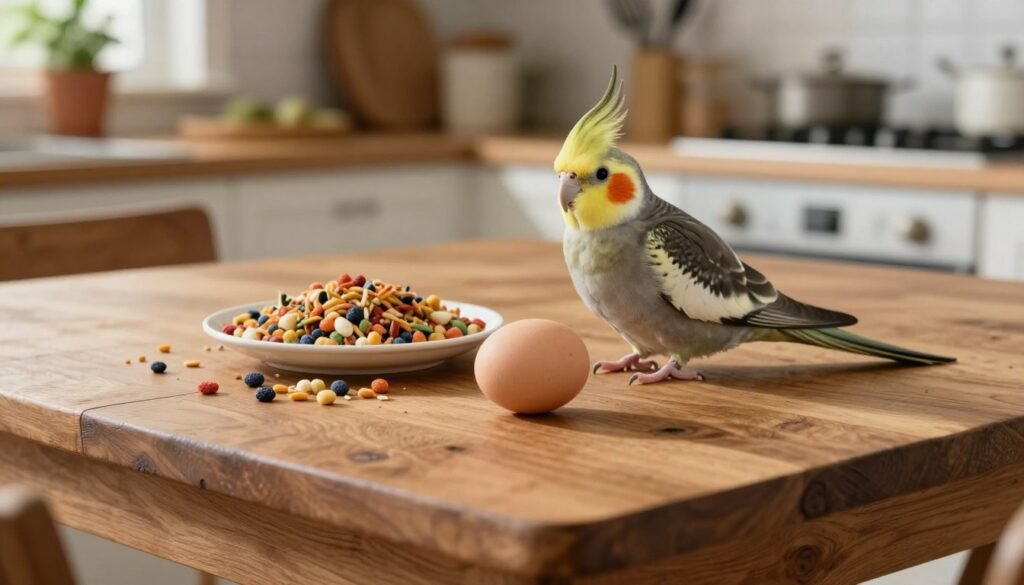
A teaspoon is a suitably small serving of people food for a cockatiel, not a miniature meal to add every day. Plain cooked egg can be offered in a small amount, but people food does not replace a balanced diet.
Never offer avocado, onion, garlic, chocolate, or drinks containing caffeine. Some ingredients can be toxic to birds, while others can cause serious health problems when served often or in large amounts.
Small Servings of Suitable People Food
A teaspoon is an appropriate small serving, about the size of a dinner-plate-sized portion for a person. Plain cooked egg is one example of a people food you may offer in that amount. Keep it an occasional addition, not a replacement for the foods that make up the balanced daily menu.
Choose plain food rather than a prepared dish with added salt, fat, sugar, or seasonings. Those extras can cause serious health problems even when an ingredient is not technically toxic. A tiny serving is still too much if the food contains a dangerous ingredient.
Ingredients and Foods to Keep Away
Keep these foods and ingredients out of your cockatiel’s reach:
- Avocado, which contains persin reported as a cardiac toxin to birds.
- Onion and garlic, including concentrated forms such as garlic powder and onion soup mix.
- Chocolate and drinks containing caffeine, such as coffee or tea.
- Apple seeds and the pits of cherries, plums, apricots, and peaches.
- Rhubarb leaves.
Avocado poisoning can involve respiratory distress within 12 hours, with death potentially occurring within one to two days. Chocolate contains theobromine and caffeine, which can cause hyperactivity, an increased heart rate, tremors, possible seizures, and death at a toxic dose. Apple seeds and stone-fruit pits contain cyanide, while rhubarb leaves contain oxalate crystals that can cause kidney problems.
Dairy products are not technically toxic, but birds cannot digest lactose, and increased amounts can cause diarrhea. Keep salty, fatty, and sugary table foods out of regular feeding because they can harm health. If your bird may have eaten avocado, chocolate, or another dangerous ingredient, contact an avian veterinarian promptly.
Switch a Seed-Eating Bird to Pellets Gradually
A seed-eating cockatiel may need days, weeks, or months to accept pellets, so change its food gradually. Some birds do not recognize pellets as food at first, making small experiments more useful than a sudden swap.
Keep familiar food available until you know your bird is eating pellets reliably. Try one introduction method at a time and watch how your cockatiel responds. A change that works for one bird may not interest another.
Introduce Pellets Without Removing Familiar Food Too Soon
You can introduce pellets in several ways while keeping the familiar food in the routine:
- Mix a small amount of pellets with the familiar food.
- Scatter a few pellets on a flat surface for exploration.
- Grind pellets onto a small amount of moist food.
Use a clean, flat surface so you can tell whether the bird has picked up the pellets. A moist food coating can help some birds notice their taste, but remove that serving after the meal. Avoid assuming that a few nibbles mean the bird has started eating enough.
Check Intake and Weight During the Change
Watch your cockatiel’s actual intake and body weight while changing the menu. A loss of more than 1-2% of body weight in a week means the change is happening too fast. Weighing the bird regularly can reveal a problem before a food bowl does.
A bird that is not eating reliably needs help with the transition. Contact an avian veterinarian for advice, especially if your cockatiel refuses pellets or its weight falls past that threshold. A veterinarian can help you adjust the approach without leaving the bird short of food.
Do not withdraw the familiar food until you have confirmed that the bird is reliably eating pellets.
Keep Fresh Water Available and Dishes Clean
Your cockatiel should have access to fresh, clean water throughout the day. Continuous access matters, so keep water in the cage rather than offering it only at meal times.
Wash water and food dishes every day with soap and water. Food and water bowls need regular cleaning even when they look clean. A daily wash is a simple part of keeping the cage’s feeding area in good condition.
Use soap and water to clean each dish, then rinse it well before filling it again. Check that the water container is easy for your bird to reach and that the dish has not tipped over. A bowl that is empty or blocked does not provide dependable access.
Make dish washing part of the daily cage routine. Clean the food dish as well as the water dish, and use clean water when you refill it. That gives your cockatiel a fresh supply after the bowl has been washed.
Refill the water dish with clean water after its daily wash.
Use Supplements Carefully and Skip Grit
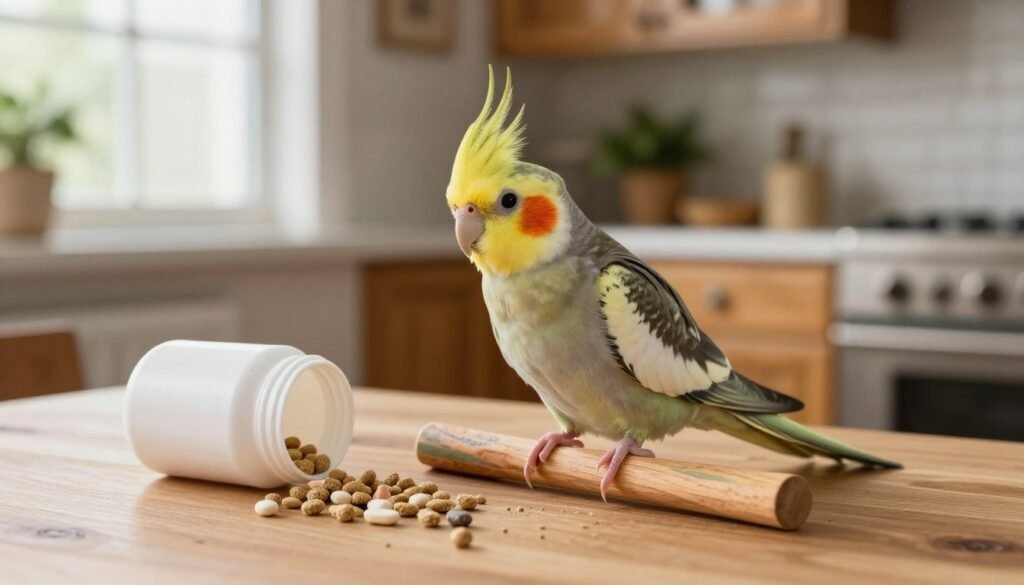
A cockatiel eating a balanced pellet-based diet generally does not need extra vitamins or minerals unless an avian veterinarian recommends them. More is not safer with supplements, since excess vitamin A can also cause harm.
Use specific vitamin or mineral supplements only under an avian veterinarian’s guidance. Cockatiel findings show why guessing at a dose can be risky.
Ask Before Adding Vitamins or Calcium
A diet containing 30,000 μg vitamin A/kg was associated with greater plasma retinal concentrations, intensified vocalization patterns, pancreatitis, and multifocal lymphocyte accumulation in the duodenum after 269 days. In an adult cockatiel experiment, dietary vitamin A concentrations of 3,000 μg/kg or higher caused signs of toxicity.
A diet containing 0 μg/kg vitamin A reduced the secondary antibody response after 225 days and altered vocalization patterns. These findings show that both excess and too little vitamin A can have effects. They are a reason to avoid adding vitamins without professional guidance, not a recipe for changing your bird’s diet.
A cockatiel eating 75%-80% of its diet as pellets generally does not need supplements. If a veterinarian identifies a deficiency or another specific need, follow the recommended product and amount rather than adding several supplements on your own.
Leave Grit Out of the Cage
Cockatiels are parrots and do not need grit to digest their food. A bird that is unwell may overeat grit, which can potentially cause an intestinal blockage. Leave grit out of the cage unless an avian veterinarian gives you a specific reason to use it.
Ask an avian veterinarian before adding a supplement, particularly when a bird has a known deficiency or reproductive needs.
Adjust Feeding for Life Stage and Health Needs
A cockatiel’s usual feeding routine may need adjustment during egg-laying, chick-rearing, illness, injury, or early development. Individual needs can differ from the routine that works for a healthy adult.
Very young, stressed, injured, egg-laying, and chick-rearing birds may have special nutritional requirements. Some pellet formulations are made for different life stages, so the appropriate choice can depend on the bird’s situation.
Special needs can arise in several situations:
- Very young birds still developing.
- Birds under stress.
- Birds recovering from injury.
- Egg-laying birds with changing calcium needs.
- Birds raising chicks.
Do not assume that one change, such as adding calcium, is right for every bird in these situations. Egg-laying can affect calcium needs, and an avian veterinarian can advise on an individual bird’s requirements. A veterinarian can also help you choose a formulation suited to the bird’s life stage.
Get veterinary guidance before changing the diet to meet a specific life-stage or health need.
Monitor Eating and Know When to Call a Veterinarian
A noticeable change in how much your cockatiel eats deserves attention, especially when its behavior or breathing also changes. Track each bird every day so you can recognize a lasting drop instead of relying on a quick glance at the bowl.
A sustained drop in eating with signs of illness warrants a same-day or next-day call to an avian veterinarian. Watch for changes such as:
- Listlessness or fluffed feathers while resting.
- Nasal discharge.
- Clicking respiration or tail bobbing.
- Open-beak breathing.
- Vomiting.
These signs do not diagnose a nutritional problem, but they help you describe what has changed. Note when the reduced eating began and which signs you observe. That clear information can help the veterinarian assess your bird’s situation.
Breathing difficulty, including tail bobbing or open-beak breathing, requires same-day veterinary care.
When you call, describe the change in eating and any signs you have seen. Treat breathing difficulty as a same-day veterinary concern.
Conclusion
A steady feeding routine is built from appropriate staple food, fresh choices, clean water, and close attention to what your bird eats. Consistency makes it easier to notice whether your cockatiel is accepting its daily diet or leaving important foods behind.
Use the bowl as a practical check, not just a place to put food. Your bird’s habits, life stage, and health can affect the right approach, so ask an avian veterinarian for help with individual needs.
Check your cockatiel’s current food bowl today and contact an avian veterinarian if you need help changing its diet.